Burj Al Arab is Dubai’s great coastal landmark: a white sail rising above the sea rather than another tower in a dense skyline. Its architecture, service history and spectacular helipad events explain the fascination. But a useful visitor guide must begin with what has changed, not with an old booking offer.
Important 2026 restoration update
On 15 April 2026, Jumeirah announced an approximately 18-month restoration led by interior architect Tristan Auer. Reporting also describes a temporary closure. Do not assume suites, Inside Burj Al Arab tours, restaurants or lounges are operating normally. Obtain explicit confirmation for your dates from Jumeirah before paying a hotel, tour reseller or restaurant deposit. An old listing that still has a “book” button is not confirmation of access.
The experiences below describe the hotel’s established identity and what to investigate for a future visit. They are not an assertion that every venue is currently available. The operator’s approximate restoration duration should not be treated as a guaranteed reopening date. If your main goal is a photograph, you can plan around permitted public viewpoints instead of entering the hotel.
A dhow sail with an island beneath it
Architect Tom Wright of WS Atkins drew on the sail of an Arabian dhow, connecting a modern luxury address to the Gulf’s maritime heritage. Jumeirah describes the building as 321 metres tall, standing on an artificial island about 280 metres from shore. The island separates it visually from the coastline; the curving private causeway makes arrival part of the architectural experience.
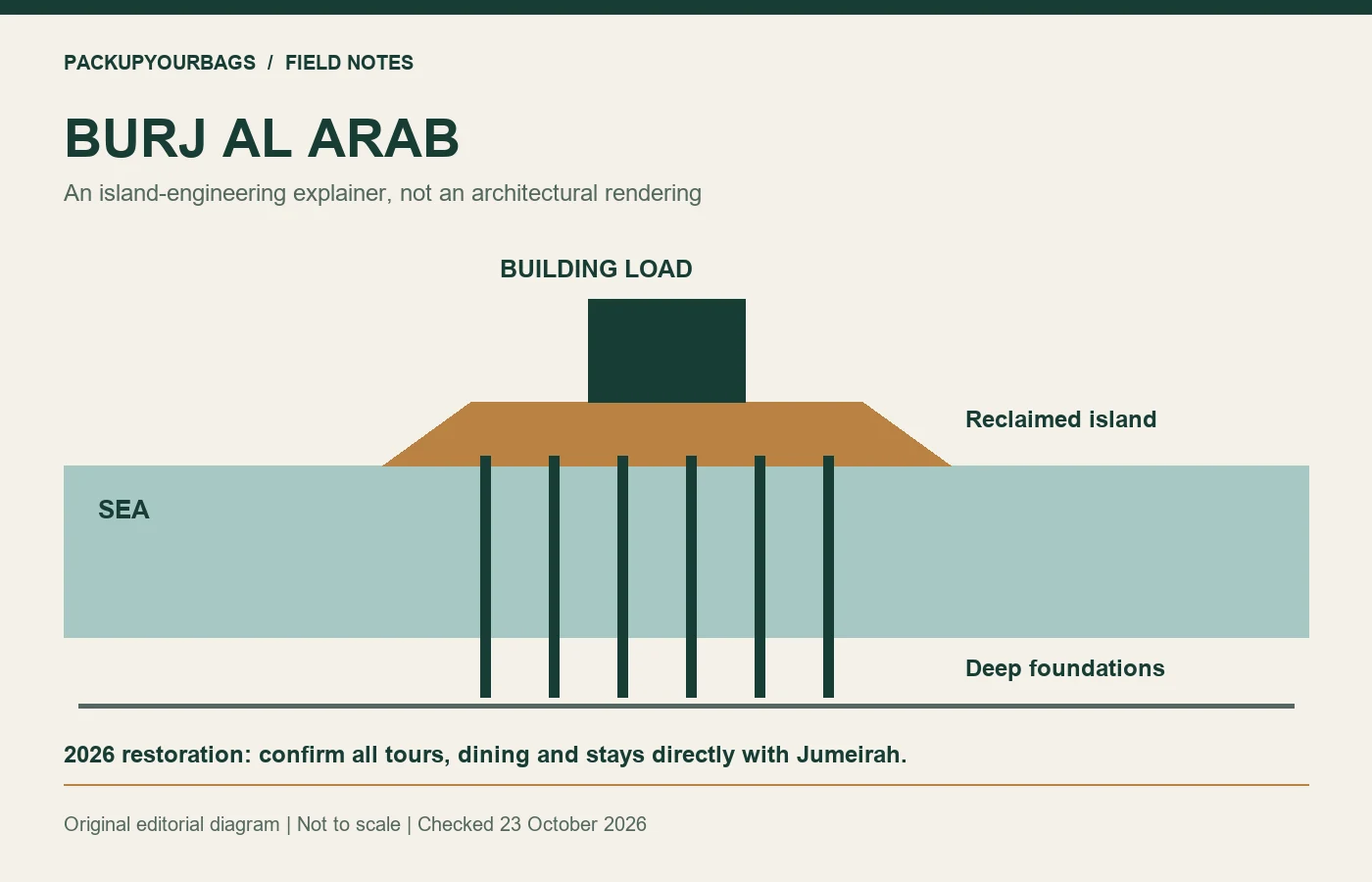
The difficult engineering lies below that elegant silhouette. The site needed a stable foundation in a marine environment, protection against waves and careful attention to groundwater and corrosion. Deep concrete piles and a substantial foundation transmit the building’s loads below the reclaimed surface. The conceptual graphic accompanying this guide explains load paths; it is not an engineering specification or an exact reconstruction of the hotel.
Why “seven-star” needs an explanation
“Seven-star hotel” is a famous description, not a universal official hotel-classification category. Jumeirah itself recounts the phrase as journalistic enthusiasm at the hotel’s launch. Book against the actual suite category, services and written terms rather than treating “seven stars” as a standardized promise. The property opened in 1999 and became associated with duplex accommodation, butler service and highly theatrical interiors.
The helipad stories: extraordinary, but not a public attraction
In February 2005, Roger Federer and Andre Agassi hit tennis balls on a temporary court on the helipad for a promotional event. It was not a permanent tennis club that guests can reserve. In March 2023, pilot Luke Czepiela landed a specially modified Carbon Cub aircraft on the platform, a carefully prepared stunt documented by Red Bull and the aircraft manufacturer. These events explain the helipad’s fame; neither is a visitor experience offered by an ordinary tour ticket.
The broader lesson is practical: photographs of sporting or entertainment events do not establish public access. Never buy an offer promising unrestricted helipad entry without confirmation from the hotel. The same caution applies to helicopter arrival packages, which depend on permissions, operators, weather and current arrangements.
Guided inside tours: what to check
The established Inside Burj Al Arab experience introduced visitors to spaces such as the atrium, Royal Suite and an Experience Suite. It offered an alternative to booking an overnight stay. During restoration, ask whether the specific tour is operating, which rooms are accessible, whether the itinerary has changed and what happens if works affect the visit.
Book through the operator or a clearly identified authorized seller. Check the meeting point, transport from the visitor reception, ID requirements, arrival margin, child rules, permitted cameras and refunds. A guided tour is not free movement through a working hotel. Avoid copying old tour prices into your budget: availability and package contents matter more than a historical headline rate.
Dining and suite experiences
The hotel’s familiar dining names include the sky-high Al Muntaha and the aquarium-side Al Mahara. These are different settings: the latter’s marine atmosphere should not be confused with an underwater building beneath the sea. Confirm the venue’s current opening, menu and reservation policy directly. Also check dress requirements, age restrictions, minimum spend and cancellation charges.
For a future suite stay, compare more than the room photograph. Ask about sleeping arrangements, accessibility, transfers, dining inclusions, beach and pool access, taxes and any ongoing works. A butler service does not mean every extra is included. For now, nearby operating hotels may be more practical; ask whether your room or restaurant table actually faces Burj Al Arab.
Beach photography without a luxury booking
The public beach area traditionally known as Umm Suqeim or Sunset Beach has been a familiar mainland viewpoint. Coastal construction, fencing and access routes can change, so check local signs and current public access on arrival. If the preferred stretch is unavailable, move to another permitted public coastal path rather than entering a hotel beach or walking around barriers.
Souk Madinat Jumeirah can offer attractive framed views from some public circulation areas, while restaurant terraces may require a purchase or reservation. It is not the same as a free public beach. Ask before using private decks or setting up equipment. Beaches belonging to Jumeirah hotels are subject to their guest and day-pass rules.
For a clean composition, keep the horizon level and try both a wide shoreline view and a closer sail detail from a lawful viewpoint. Morning and evening light create different results; check the sun’s direction rather than assuming sunset lights every façade equally. Never frame current works out of an image and label it as proof that the whole hotel is open. Respect beachgoers’ privacy and local commercial-photography rules.
Is it worth visiting now?
For architecture enthusiasts, the exterior can still be a worthwhile stop when public access permits. For an inside tour, special dinner or overnight stay, first establish that the service is genuinely available. Pair the coast with our Burj Khalifa visitor guide for a contrasting look at Dubai’s vertical and maritime identities.
Sources and image notes
Sources checked 23 October 2026. Prices, access and booking conditions can change; use the linked official operator before paying.
- Jumeirah: April 2026 restoration announcement
- Jumeirah: architecture, island and seven-star origin
- Jumeirah: Inside Burj Al Arab experience
- Dubai Media Office: original guided tour launch
- ATP Tour: Federer and Agassi helipad event
- Red Bull: Luke Czepiela aircraft landing
- Jumeirah: current reservations and hotel information
- The National: April 2026 temporary closure reporting
- Jumeirah official hotel overview
- Brand Dubai: landmark photography locations
Image: original PackUpYourBags explanatory graphic. It is not a photograph, an as-built architectural drawing, or a map to scale.