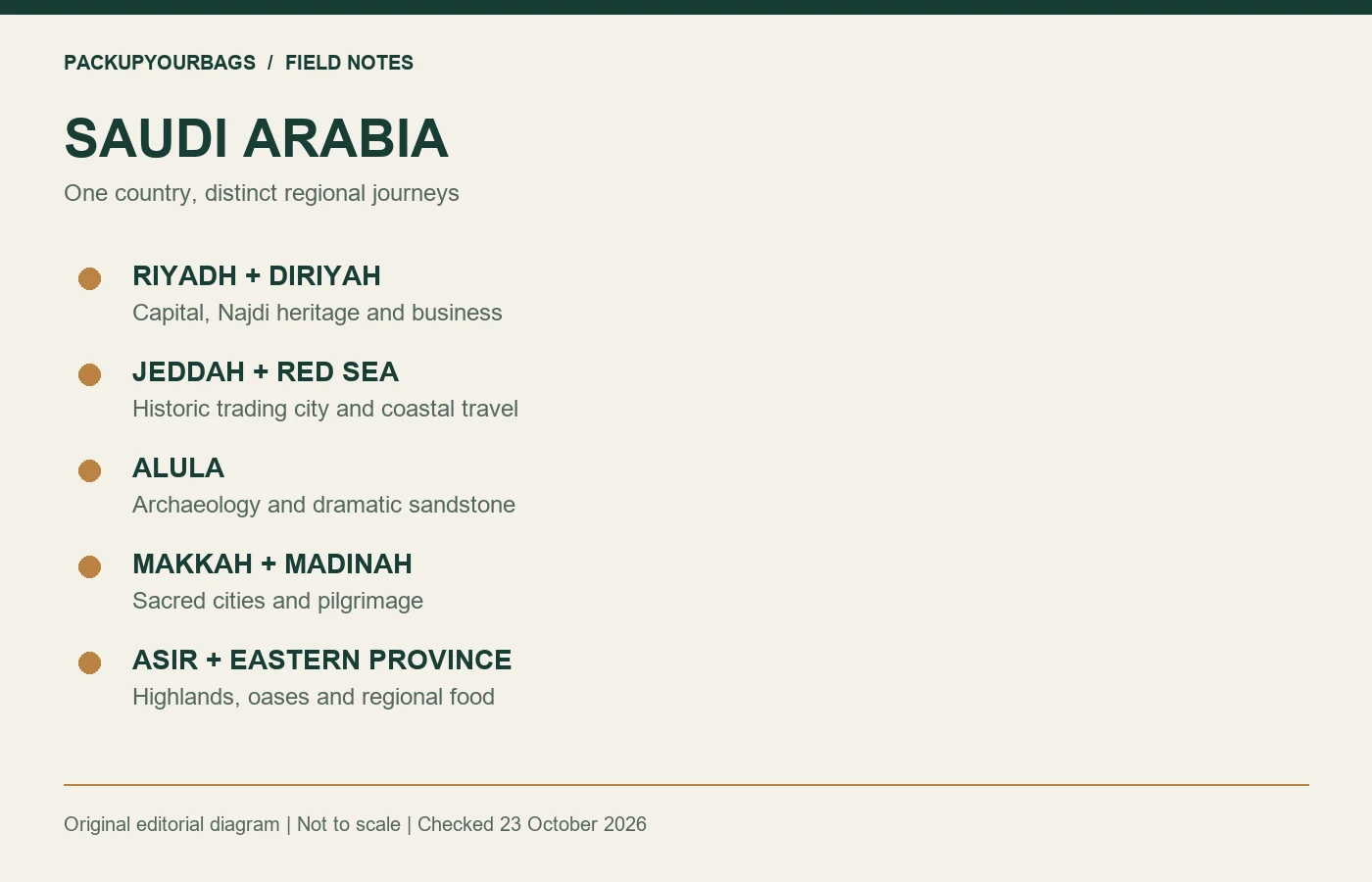
Saudi Arabia is easier to understand as a collection of regions than as a single desert itinerary. Riyadh’s capital-city energy, Jeddah’s trading heritage, AlUla’s sandstone landscapes, the southwest’s highlands and the spiritual life of Makkah and Madinah belong to the same country, but they ask for different kinds of visits. This overview connects the history, culture and economy before you choose where to go.
A short history: three different milestones
The Arabian Peninsula’s history reaches far beyond the modern kingdom, through ancient settlements, caravan routes and trading connections. The emergence of Islam in the seventh century transformed Makkah and Madinah into the central sacred geography of the Muslim world. Later political history includes the First Saudi State associated with Diriyah, a subsequent Saudi state, and the modern kingdom.
Do not confuse the commemorative dates. Founding Day, on 22 February, recalls the First Saudi State in 1727. National Day, on 23 September, marks the proclamation of the unified Kingdom of Saudi Arabia in 1932 under King Abdulaziz. They celebrate different events, even though both may involve heritage programmes and national colours. The Ministry of Foreign Affairs and official tourism calendar explain the distinction.
Rulers and government
The modern kingdom’s monarchs have been Abdulaziz, Saud, Faisal, Khalid, Fahd, Abdullah and Salman. As checked for this guide, King Salman bin Abdulaziz Al Saud is the monarch, while Crown Prince Mohammed bin Salman bin Abdulaziz Al Saud is Prime Minister. Saudi Arabia is a monarchy; a crown prince and a king are not interchangeable titles.
For visitors, the useful basics are simpler: the capital is Riyadh, the official language is Arabic and the currency is the Saudi riyal, abbreviated SAR. English is widely encountered in many tourism and business settings, but learning greetings and using correct names makes everyday exchanges easier. Avoid treating a tourism experience as an explanation of every aspect of the country’s political or social life.
Where to go: match the region to the trip
- Riyadh and Diriyah: combine the capital with Najdi heritage at At-Turaif and dining around Bujairi Terrace. Check admission and reservations for your actual date.
- Jeddah: explore the historic trading-city atmosphere of Al-Balad and the Red Sea waterfront. Allow time to walk rather than making it a quick photograph stop.
- AlUla: choose guided heritage and landscape experiences, with advance booking for protected sites such as Hegra.
- Makkah and Madinah: plan around worship and access rules, not a generic sightseeing schedule. Makkah is restricted to Muslims; mosque access in Madinah also requires attention to sacred-area rules.
- Asir and the southwest: consider highland scenery and regional architecture. Do not assume the weather is identical to Riyadh or the coast.
- Eastern Province and Al-Ahsa: look at oases, Gulf-facing urban life and the country’s industrial geography.
Choose two or three connected bases for a first journey. Saudi distances are substantial: flights, trains where available and intercity roads are different planning decisions. A dramatic photograph can hide several hours of travel. Confirm the actual station or airport transfer and avoid booking an activity immediately after a long arrival.
Food: start with regional variety
Kabsa, a rice-and-meat dish, is a familiar introduction; jareesh, made with cracked wheat, is recognized as the national dish. These should be the start of a food journey, not its whole definition. Look for regional cooking, date varieties, breads, seafood on the coast and Saudi coffee served with hospitality rituals. Ingredients and preparation vary by household and region.
For a good food itinerary, alternate one destination restaurant with neighbourhood cafés and everyday meals. Ask about spice, portion size and allergens rather than assuming all dishes are mild or share the same ingredients. Hospitality is often expressed through generous serving, but accepting a cup of coffee is not permission to photograph your host or their home. Ask first.
Festivals and culture
Founding Day and National Day follow fixed Gregorian dates. Ramadan, Eid al-Fitr and Eid al-Adha follow the Islamic calendar, so their Gregorian dates move and official announcements matter. During Ramadan, opening hours, traffic and restaurant service can differ from an ordinary month. Plan evenings and meal stops accordingly.
Entertainment seasons and festivals have event-specific dates and tickets. Do not assume that a Riyadh Season attraction remains open all year or that a previous year’s programme will repeat. Use the official Visit Saudi calendar for the exact event, venue and age rules. Traditional dress, crafts, poetry, music and regional architecture provide cultural context beyond headline concerts.
Business and the economy
Oil and related industries remain important, while Vision 2030 emphasizes a more diversified economy. Tourism, logistics, manufacturing, mining, technology and services create different opportunities; none is an automatic promise of demand or profit. A business idea needs a customer, a permitted activity and a realistic operating budget.
For foreign investment, begin with the Ministry of Investment’s current registration guidance and activity-specific requirements. Then establish the entity, commercial registration, sector approvals, premises, banking and employment arrangements that apply. Business ownership, residence permission and permission to work are separate questions. Do not apply a UAE free-zone package to Saudi Arabia or assume every activity allows the same ownership conditions.
Budget for registration and professional help, premises, insurance, accounting, staff, visas where applicable, sector permits and recurring compliance. This overview intentionally does not quote a universal setup price or call the country a tax haven: the cost and tax treatment depend on the entity, activity and circumstances. Use MISA and the relevant tax and business authorities for your actual case.
Practical travel preparation
Check visa eligibility against your passport and residence status before buying non-refundable travel. A tourist visa does not authorize Hajj or local employment. Verify medical-entry requirements with the current official guidance, choose accommodation around the purpose of the trip, and keep digital and offline copies of confirmations. Dress respectfully and ask before photographing people or restricted facilities.
For the next stage, read our Makkah and Madinah guide and Vision 2030 project explainer. They separate pilgrimage planning and announced development ambitions from ordinary tourist access.
Sources and image notes
Sources checked 23 October 2026. Prices, access and booking conditions can change; use the linked official operator before paying.
- Saudi Ministry of Foreign Affairs: country overview
- Saudi Ministry of Foreign Affairs: history
- Saudi government: Kingdom and leadership overview
- Saudi Central Bank: Founding Day and National Day dates
- Visit Saudi: Founding Day
- Saudipedia: kabsa and jareesh
- MISA: current investment registration FAQs
- Visit Saudi: official destination and event information
- Diriyah: current visitor access
- Official Saudi eVisa: permitted tourism activities
Image: original PackUpYourBags explanatory graphic. It is not a photograph, an as-built architectural drawing, or a map to scale.