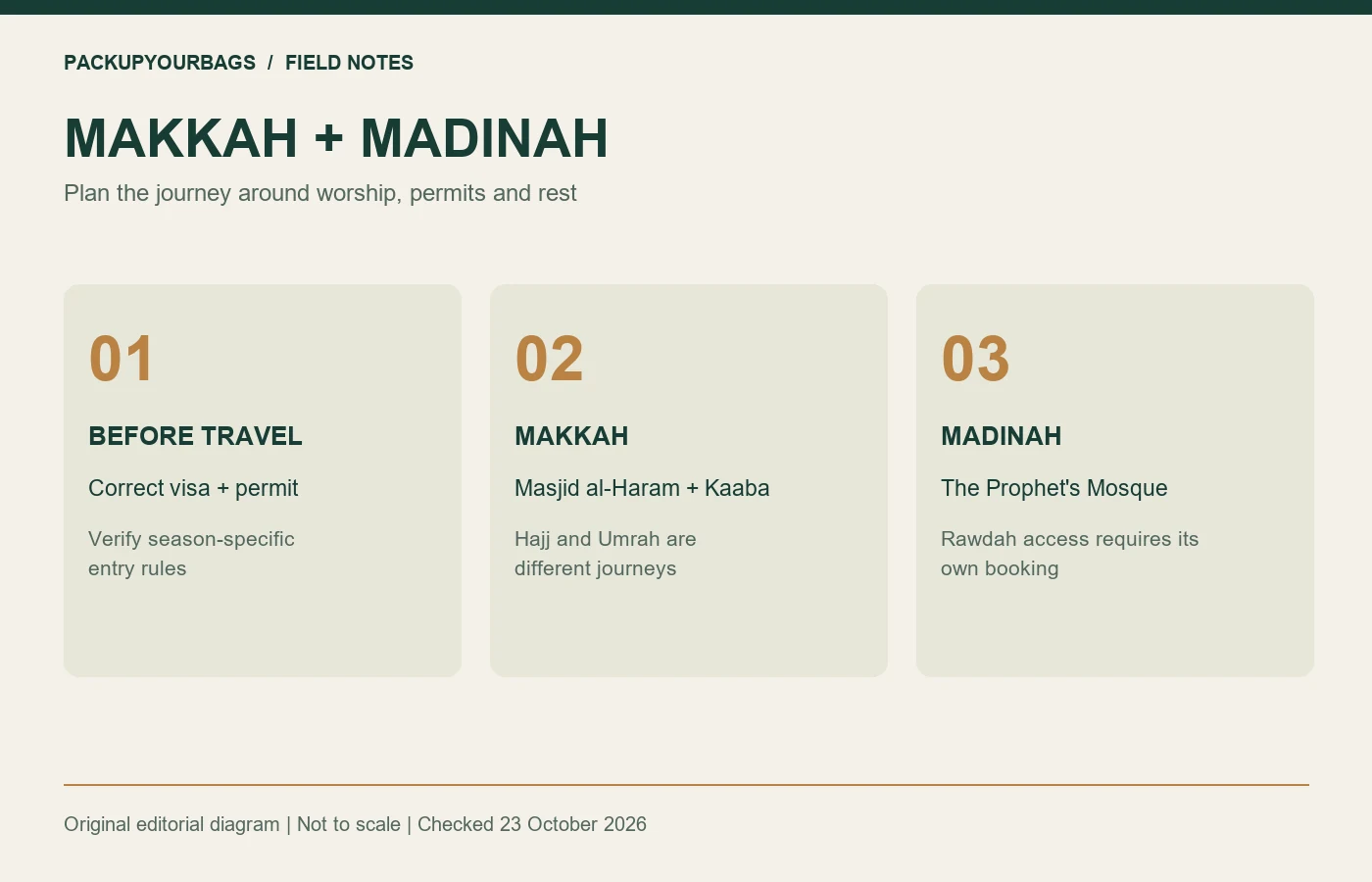
For Muslims, Makkah and Madinah are places of worship, memory and belonging before they are destinations. A thoughtful journey leaves room for prayer, rest and the needs of other pilgrims. Understanding the sacred geography and arranging the correct permissions is more important than fitting the largest number of stops into a day.
Makkah: the Kaaba and the direction of prayer
The Kaaba stands within Masjid al-Haram, the Grand Mosque in Makkah. Muslims around the world face its direction, the qibla, in prayer. Within Islamic tradition, the Kaaba is associated with Prophet Ibrahim and his son Ismail. Pilgrims perform tawaf around it as part of prescribed rites; the building itself is not worshipped.
The sa’i between Safa and Marwah recalls Hajar’s search for water in Islamic tradition. Zamzam is deeply connected with this sacred history. These are not ordinary sightseeing stops, and practical decisions about where to walk or pause should follow staff instructions and the needs of those performing worship. Avoid stopping moving crowds for a photograph or trying to touch a location at the expense of others’ safety.
Madinah: the Prophet’s Mosque and early Islamic history
Madinah is associated with the Prophet Muhammad’s migration, or Hijrah, from Makkah and the development of the early Muslim community. Al-Masjid an-Nabawi, the Prophet’s Mosque, is central to a visit. The Rawdah has particular religious significance and its access is managed through designated appointments; a general mosque visit and a Rawdah reservation are not the same thing.
Quba Mosque, the Uhud area and heritage sites help visitors understand the community’s early history. Use knowledgeable guides and respect any barriers or restrictions. Visiting Madinah is deeply valued, but it is not a required ritual of Hajj or Umrah. Do not let a commercial itinerary blur that distinction or suggest that buying extra excursions completes a religious obligation.
Hajj and Umrah: the essential distinction
Hajj takes place during specified days of Dhu al-Hijjah and involves rites and locations beyond an Umrah visit, including Arafat, Muzdalifah and Mina. It requires the correct Hajj arrangements and authorization. Umrah includes ihram, tawaf, sa’i and completion through the prescribed hair-cutting or shaving practice. Its access is also subject to the current permit and seasonal rules.
A tourist, transit or Umrah visa must not be assumed to authorize Hajj. Requirements depend on your nationality, residence and the season’s official arrangements. International pilgrims should use the official route applicable to their country; Nusuk Hajj serves eligible markets, while other national arrangements may apply. Domestic Hajj applicants have their own permit and package process. This guide is a planning introduction, not a substitute for an authorized religious guide or a ruling on individual circumstances.
Before paying for a package
- Confirm your passport details, visa type, permitted dates and the relevant Hajj or Umrah authorization.
- Use official Nusuk and Ministry of Hajj and Umrah information. Check the seller’s identity and authorization rather than relying on a forwarded message or social-media logo.
- Ask for hotel names, room occupancy, actual walking or shuttle routes, meals, transfers and cancellation conditions in writing.
- Separate the visa, ritual permit, Rawdah appointment and transport reservation. One confirmation does not automatically provide the others.
- Verify the current year’s entry and health requirements with the responsible Saudi authorities and your travel provider before departure.
An Umrah permit and Rawdah appointment can be managed through the designated official systems, including Nusuk. Check availability before constructing a tight itinerary. Around Hajj, Makkah entry controls and Umrah travel windows can change. A previous pilgrim’s experience or last year’s date is not evidence that you may enter this season.
Arrivals, trains and hotel location
Choose flights and ground transport around the route you actually intend to follow. Jeddah and Madinah are common gateways, but immigration, baggage and local transfers still need time. Haramain High Speed Railway can connect key stations; verify the current route, train, baggage allowance and departure station directly with the operator. A ticket to Makkah station does not remove the need for a final transfer to your accommodation or the mosque area.
When comparing hotels, measure the practical route to a usable entrance, not only the straight-line distance on a map. Hills, closures, crowds, shuttle frequency and your group’s mobility can change the experience. Ask whether wheelchair assistance or accessible rooms must be booked separately. Avoid placing a demanding excursion immediately after a long flight or ritual session.
A manageable daily rhythm
Keep water, weather-appropriate clothing, essential medication prescribed for you and a reliable means of contacting your group. Seek current health advice from official sources and a clinician for your own needs. Plan rest and shade; do not make a strenuous mountain ascent an assumed requirement of pilgrimage. Visits associated with early Islamic history can be meaningful without every visitor undertaking difficult terrain.
Agree on meeting points that remain useful if mobile coverage or battery fails. Write down accommodation details and keep identification secure. Follow mosque staff’s directions on entrances, designated prayer areas, bags and movement. Ask for help early when someone is tired or separated instead of pressing on to preserve an itinerary.
Heritage, food and hospitality
The Hijaz has long received travellers from many parts of the Muslim world. That history is visible in food, shops and a multilingual atmosphere. Dates, coffee and shared meals can be part of the journey, but accommodation and dietary needs differ from person to person. Use licensed food outlets and ask about allergens. Buy Zamzam only through authorized arrangements and check airline baggage rules before departure.
Dress modestly, protect the privacy of worshippers and avoid intrusive filming. Rules for photography, livestreams and commercial equipment can differ by location and change over time; obey current signs and staff. Makkah is restricted to Muslims. Visitors to Madinah must check the rules for sacred areas and the mosque rather than assuming every part of the city has identical access.
A final planning check
Before leaving, confirm visa validity, permits, Rawdah slot if wanted, hotel and transport, official health requirements and an emergency contact plan. Give worship and rest priority over a checklist of paid visits. For wider context, see our Saudi Arabia country guide.
Sources and image notes
Sources checked 23 October 2026. Prices, access and booking conditions can change; use the linked official operator before paying.
- Saudi national portal: Hajj and Umrah procedures
- Nusuk: Umrah journey and visa distinctions
- Nusuk: Umrah permit service
- Saudi national portal: domestic Hajj permit service
- Nusuk Hajj: official international platform
- Ministry of Hajj and Umrah: official guidance
- Haramain High Speed Railway: schedules and baggage
- Saudi Ministry of Health: current pilgrim health guidance
- Nusuk: sacred-city heritage
- Saudi Press Agency: visit visas do not authorize Hajj
- Haramain authority: sacred mosques
Image: original PackUpYourBags explanatory graphic. It is not a photograph, an as-built architectural drawing, or a map to scale.