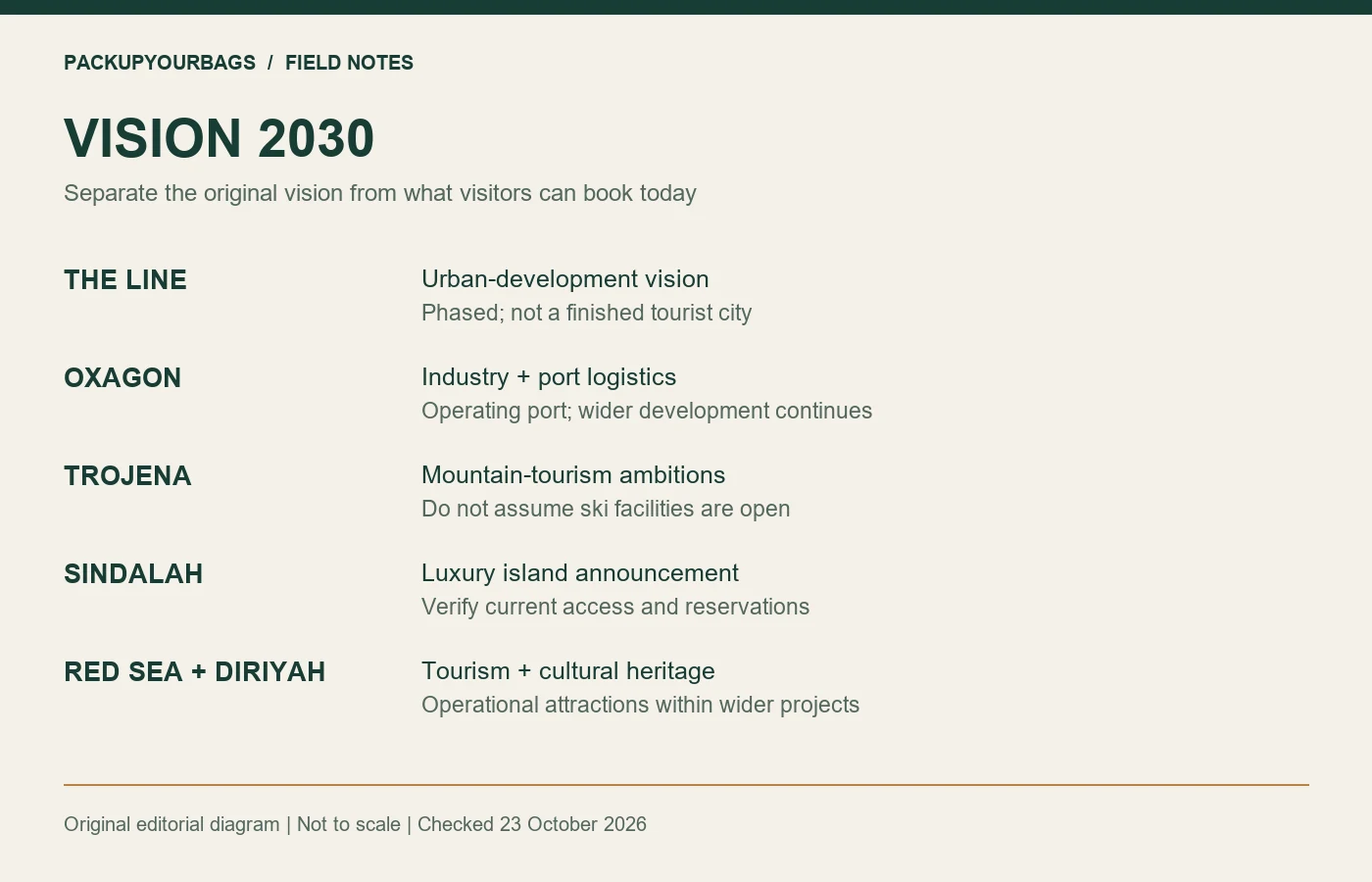
Saudi Arabia’s Vision 2030 projects are often presented through spectacular images: mirrored urban walls, a floating industrial district, mountain ski slopes and island resorts. Those images describe different kinds of ambitions. Some projects already contain operating destinations; others remain phased developments whose designs, priorities and schedules can change. Understanding that distinction is essential for travellers, job seekers and businesses.
What Vision 2030 is trying to change
Vision 2030 is a national transformation programme, not a single property development. Its economic logic includes expanding activity beyond oil, attracting investment, developing tourism and entertainment, and improving services and employment opportunities. Large construction projects are visible symbols, but logistics, industry, public transport, culture and skills also matter.
NEOM is one part of that wider landscape in northwest Saudi Arabia. It should not be used as a synonym for all Saudi mega-projects. The Red Sea destination and Diriyah have different locations, operators and visitor arrangements. A country’s long-term programme is also not a guarantee that every announced component will finish by the same date.
THE LINE: the original urban vision and today’s wording
THE LINE attracted attention through a proposed car-free linear city, with closely connected services and ambitious environmental goals. Earlier project descriptions presented a structure stretching 170 kilometres and rising 500 metres. Those are original proposal figures, not the dimensions of a completed, occupied city that tourists can visit today.
The official page checked for this article now describes a phased, demand-led approach. Its language emphasizes livability, sustainability and innovation rather than presenting a finished destination. That change matters: do not use old renderings as current construction photographs, sell a sightseeing day in a completed vertical city, or promise a delivery date without a current official basis. Evaluate each new announcement against actual procurement, construction and occupancy evidence.
Oxagon: distinguish the floating concept from the operating port
Oxagon’s original announcement included an ambitious floating-structure concept and a new industrial ecosystem. Its current official description focuses on advanced and clean industries, renewable-energy manufacturing, digital infrastructure and port-led logistics. These are business and infrastructure functions, not a conventional leisure resort.
Port of NEOM is operational, while expansion and the wider industrial district proceed in phases. The existence of a working port does not establish that the original floating city has been completed. Likewise, a factory agreement or investment announcement is different from a commissioned production line. Businesses should verify the specific plot, utility connection, license, transport service and handover terms relevant to them.
Trojena: mountain tourism is not proof of an open ski resort
Trojena became widely known for plans involving mountain hospitality and skiing. NEOM’s current regional page emphasizes the Jabal Al Lawz landscape, elevations up to 2,600 metres and a year-round mountain setting. That landscape exists; a fully operating resort with every originally proposed facility should not be inferred from it.
Do not book a skiing holiday on the strength of a rendering or an old target year. Require a current operating venue, confirmed transport, available accommodation and explicit dates for the activity. Weather, access restrictions and construction programmes can affect mountain visits. Artificial snow and resort infrastructure also raise practical questions about energy, water, maintenance and long-term operations that a promotional image cannot answer.
Sindalah: an island launch and current access are separate facts
Sindalah was unveiled in October 2024 as a luxury island showcase associated with NEOM, with yachting and hospitality ambitions. A launch event, however, does not prove unrestricted public access, full hotel inventory or routine reservations at a later date. At this article’s check date, the former Sindalah regional URL redirected to an Islands of NEOM page focused on marine environments.
That website change is an observation, not proof of cancellation or a reopening announcement. Before planning a stay, get current written confirmation from the destination and the actual accommodation or marina operator. Verify arrival arrangements, booking conditions, available facilities and any restrictions. Do not confuse Sindalah with the separate resorts of The Red Sea destination farther south.
The Red Sea: an operational tourism story within a wider buildout
The Red Sea destination has welcomed guests since 2023 and includes operating hospitality and airport infrastructure, alongside continuing development. It is a clearer example of a project with visitor experiences already in the market. Even here, “the destination is open” does not mean every advertised island, hotel or future facility is complete.
Start with an actual operating resort and work backward to flights, transfers and included activities. A resort on an island may require a coordinated boat or air transfer; a mainland address has different logistics. Ask whether marine activities are included, whether weather affects them and which facilities will be open on your dates. Treat environmental and regenerative-tourism claims as goals that need measured outcomes, not simply labels.
Diriyah: living heritage rather than a futuristic city
Diriyah, near Riyadh, is associated with the origins of the Saudi state and the UNESCO-listed At-Turaif district. Bujairi Terrace adds dining and public-facing experiences, while the surrounding development continues. It offers a different way to understand Vision 2030: heritage interpretation, urban place-making and hospitality rather than a new city in the desert.
Visitor admission, opening hours, events and dining-credit arrangements change by season. In particular, a summer free-access announcement is not evidence of free entry in October. Use the official Diriyah booking channels for your date and allow time for parking or road changes. Respect restored buildings as heritage sites, not just photo backgrounds.
How to read mega-project news critically
- “Announced” describes an intention. It is not the same as funded, contracted or under construction.
- “Under construction” does not mean available for a visitor or tenant.
- “Opened” may refer to one venue, a limited event or one phase; identify exactly what opened.
- A target year is not a booking confirmation or a guaranteed completion date.
- A rendering is a design illustration. It should be labelled and never presented as a photograph of the finished project.
What this means for your own plans
Travellers should choose bookable experiences and refundable arrangements where access is uncertain. Job seekers should apply through verified employers and official channels rather than paying an unofficial recruiter for a promised mega-project role. Businesses should check commercial terms and regulatory approvals for their own activity instead of assuming a project name guarantees profitability.
For a first Saudi trip, combine established regional experiences with whichever new attractions are demonstrably operating. Our Saudi Arabia guide gives that wider context, and the Makkah and Madinah guide explains why sacred-city travel follows a different framework.
Sources and image notes
Sources checked 23 October 2026. Prices, access and booking conditions can change; use the linked official operator before paying.
- Saudi Vision 2030: national programme
- NEOM: current regional overview
- NEOM: current phased approach for THE LINE
- NEOM: original THE LINE concept
- NEOM: original Oxagon announcement and floating concept
- NEOM: current Oxagon and operating port information
- NEOM: current Trojena description
- NEOM: Islands of NEOM; former Sindalah URL redirects here
- Saudi debt-management authority: 2025 circular noting Sindalah unveiling
- Vision 2030: Red Sea Global destination
- Red Sea Global: official operator
- Diriyah: official visitor information
Image: original PackUpYourBags explanatory graphic. It is not a photograph, an as-built architectural drawing, or a map to scale.