A plan to live in Italy needs a legal basis that matches your work and family circumstances. A tourist entry, a university admission and a remote-work contract are different starting points. Identify the right category before treating an apartment booking as a completed relocation.
This guide is an orientation for non-EU applicants. EU citizens and eligible family members have a different framework, and individual advice may be needed for complex situations.
Begin with the official visa route
Use the Foreign Ministry's visa information and the consulate responsible for your lawful residence. Nationality, purpose and length of stay affect the route and the evidence required.
Short-stay permission is not general authorisation to settle or work. Do not assume that any tourist can arrive first and convert to any preferred residence category later.
Employment and self-employment
The ministry explains that many non-EU work entries are subject to the Decreto Flussi quota system, with defined outside-quota categories. Employer clearance can be part of an employment route before the visa stage.
Self-employment requires its own eligibility and evidence. A company, a tax code or a professional website does not by itself grant immigration permission to carry on the activity in Italy.
Digital nomads and remote workers
Italy's official consular guidance describes a route for highly qualified remote activity, distinguishing self-employed digital nomads from remote employees. It is not a general visa for everyone who owns a laptop.
Evidence can cover qualifications or professional experience, prior work activity, income, health cover and suitable accommodation. Employment and independent arrangements have different supporting documents; follow the relevant consular checklist and current thresholds.
Do not reuse Spain's remote-work figures for Italy. A foreign employer also does not automatically remove Italian tax or social-security obligations.
Study and family pathways
Study requires the appropriate admission and, where applicable, official pre-enrolment steps. Confirm the programme, funding, insurance and any work conditions attached to the permission rather than assuming admission is enough.
Family reunification depends on the sponsor's legal status and the recognised relationship, with documentation and other requirements. Families of Italian or EU citizens may follow a different process from families joining a non-EU resident.
Elective residence and investors
Official consular guidance describes elective residence for people with adequate self-sustaining resources who will not work. It should not be sold as an alternative digital-nomad permission.
Italy also has a distinct Investor Visa programme with specified qualifying investments or donations. Buying an ordinary home is not one of its listed investment options and does not automatically establish residency.
A visa is not the final step
For a long-term stay, follow the residence-permit procedure after entry. Official guidance for national-visa holders commonly requires an application within eight working days; use the category's instructions for the competent office and method.
Keep the visa application file, entry evidence and required copies accessible. Address registration, health coverage and tax matters also need attention, but they should not be confused with the immigration approval itself.
Prepare a practical file
- Passport and identity evidence meeting the chosen route's validity rules.
- Work, study, family or financial documents as applicable.
- Required insurance, accommodation and certificates.
- Correct translations, legalisation or apostille and current fee evidence.
Is there one guaranteed timeline?
No. Clearance, appointments, visa decisions and residence-permit steps are different processes.
Where should I ask a personal eligibility question?
Start with the responsible official authority and, when needed, a qualified immigration professional. Ask for a route-specific explanation before making major commitments.
Continue planning Italy
- Plan a first trip to Italy
- Italy Explained: History, Regional Identity, Food and Local Traditions
- Colosseum Visitor Guide: Tickets, the Roman Forum and a Better Rome Day
- Sacred Italy in Assisi: Saint Francis, Art and a Respectful Pilgrim Visit
- Italy’s Rail Transformation: Naples–Bari, Sicily and the Genoa Connection
- Italy on a Budget: Rome’s Parks, Regional Food and Smarter Train Choices
- Italy Beyond the Main Circuit: Lucca, Ravenna and Regional Food Trails
- Business Setup in Italy: Registration, Self-Employment and Investor Residency
- Luxury Italy: Lake Como, Milan Style and an Unhurried Amalfi Escape
Official sources and photograph credit
Reconfirm current rules, access and charges with the responsible official source before booking or applying.
- Foreign Ministry: visa and entry questions
- Official digital nomad and remote-worker guidance
- Consular visa categories and study pre-enrolment
- Elective residence: official non-working conditions
- National visa holders: entry and residence obligations
- Official Investor Visa programme
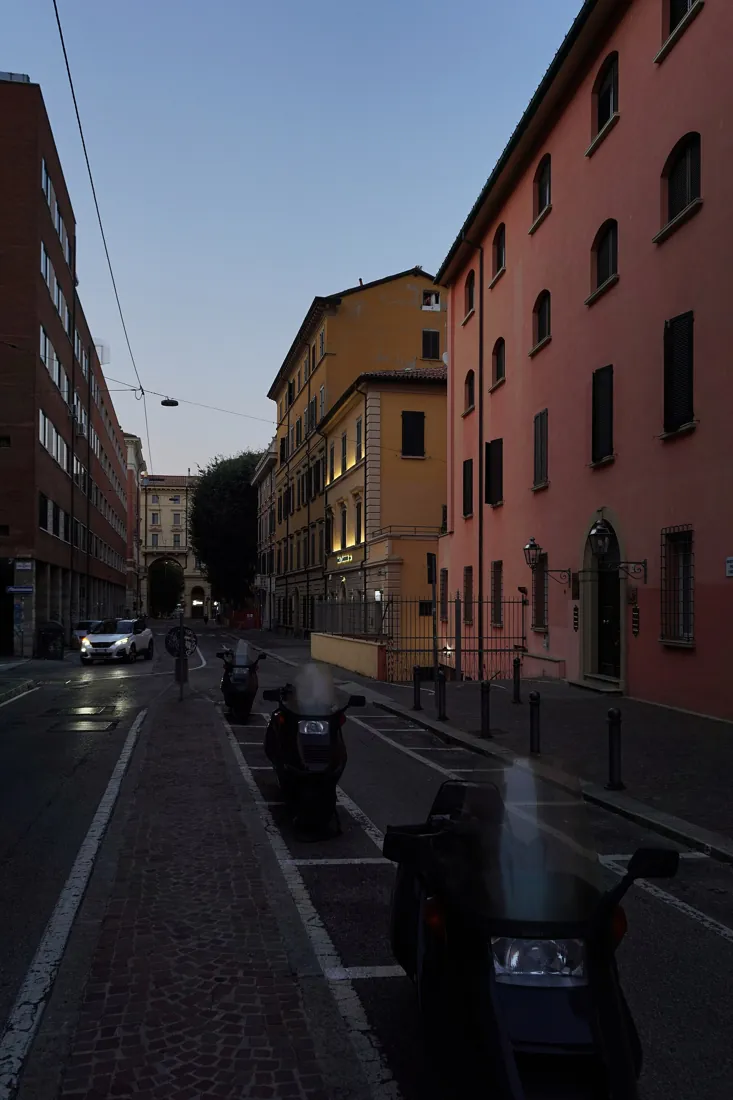
Photograph: Armin Kleiner; Bologna, Via Alessandrini, twilight.jpg; CC BY-SA 4.0. Resized and converted to WebP. Genuine archival photograph, not a live view.
