Some of Saudi Arabia’s most satisfying travel happens between headline sights: a mountain village in changing light, a canyon walk with someone who knows the route, or a shared meal that introduces a regional tradition. These experiences ask for more planning than a city museum, but not necessarily a luxury budget.
This is a menu of regional journeys, not one short road trip. Rijal Almaa, Wadi Al Disah and Al-Ahsa lie in different parts of a very large country; choose the one that fits your flights and the time you have.
Rijal Almaa: stone towers beneath the Asir mountains
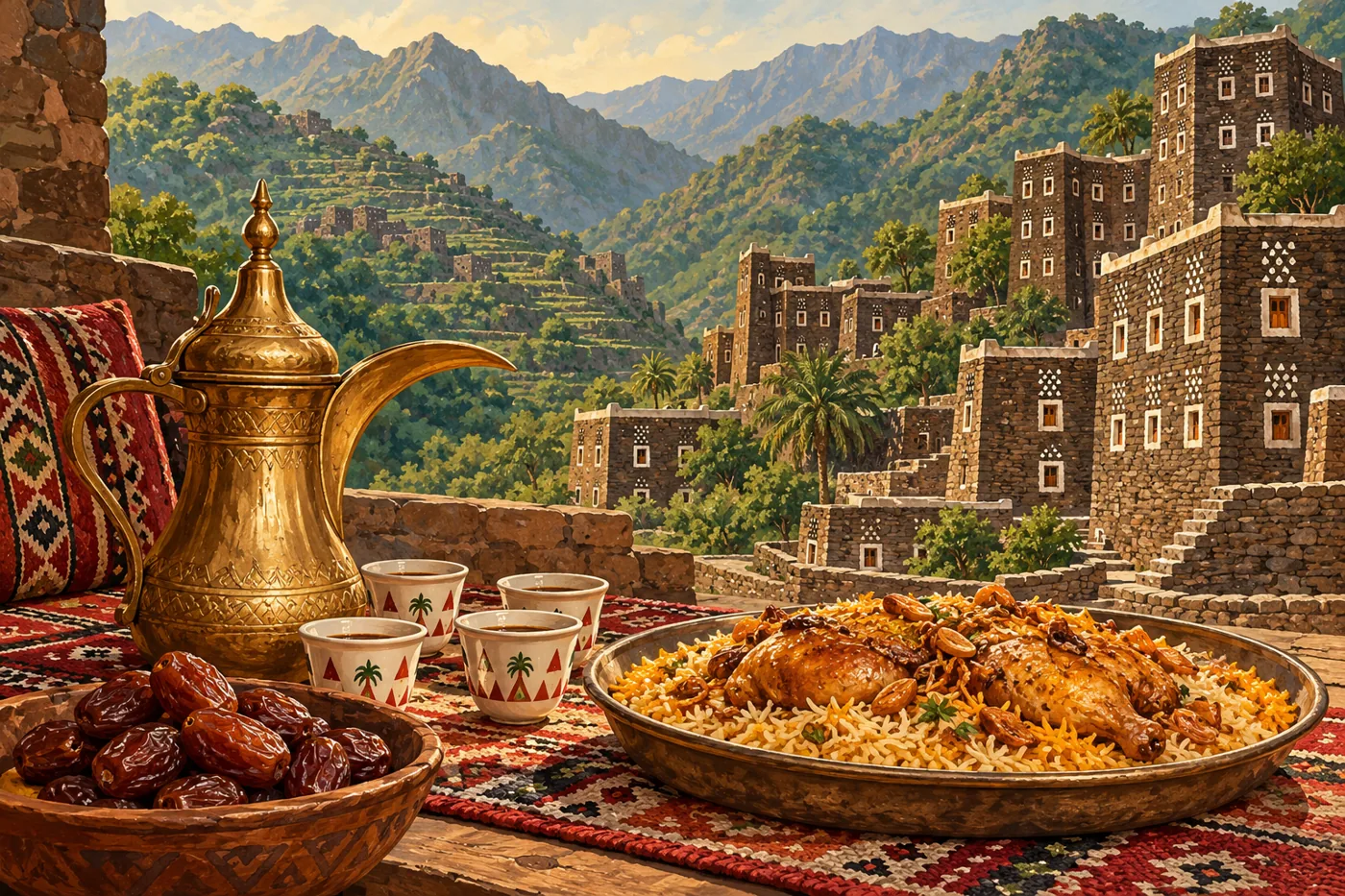
Rijal Almaa’s multi-storey stone buildings and decorative details have earned it the travel nickname “gingerbread village,” although that phrase does not describe its construction material. The real attraction is Asiri heritage and the relationship between settlement, mountain routes and local life.
Spend time looking at façades, windows and the village museum rather than racing to a single viewpoint. A local guide adds context that a photograph cannot, particularly around regional customs and the history of the buildings.
- Best timing: daylight with softer morning or late-afternoon light; leave flexibility for mountain weather and fog.
- Access and cost: confirm the current museum ticket, open buildings and parking arrangements. Public village space and a museum admission are not necessarily the same purchase.
- Transport: base the outing around Abha or another sensible Asir stop. A hired driver familiar with the winding roads can be more relaxing than self-driving an unfamiliar mountain route.
Do not turn residential life into a photo set. Ask before photographing people, stay out of private homes and follow marked access even when a shortcut looks tempting.
Wadi Al Disah: a canyon journey from Tabuk
Tall sandstone walls, palms and patches of greenery give Al Disah a landscape unlike the capital’s desert outskirts. Its beauty is best experienced at a walking pace, with the route chosen around the day’s access and weather.
Use a knowledgeable local guide or driver for unfamiliar tracks, water crossings or remote sections. A 4WD booking should still explain the route, what is included and where walking begins; vehicle type alone does not make a trip safe.
- Best timing: cooler months and daylight starts, with current weather checked before entering the valley.
- Access and cost: ordinary landscape access is not a promise of a staffed attraction with a fixed entrance tariff. Expect separate charges for guiding, transport, private land access where applicable and organised experiences.
- Transport: plan a Tabuk-region excursion with a confirmed return driver. Do not rely on finding an app taxi in the canyon.
Avoid the valley during heavy rain or flash-flood warnings, including storms upstream. Carry water, offline directions and a charged phone, and tell someone your plan rather than treating a remote hike like an urban stroll.
Jabal Al-Qarah: caves and oasis life in Al-Ahsa
The rock formations and visitor caves at Jabal Al-Qarah add a geological dimension to an Al-Ahsa stay. Pair them with Hofuf’s heritage streets and permitted oasis experiences, leaving time to understand how agriculture shapes the region.
Take the maintained visitor route, wear shoes with grip and check which areas the current ticket includes. Do not assume every opening in the rock is a public trail or safe to explore alone.
- Best timing: a cooler morning or late afternoon; use indoor cave time as part of the day, not a reason to ignore heat outside.
- Access and cost: a Visit Saudi marketplace tour lists a SAR 50 cave-entry charge, but this is a planning reference, not a guaranteed walk-up tariff. Confirm the attraction’s current total directly.
- Transport: travel to Hofuf by road or an appropriate SAR East service, then use a car or local driver for the scattered sights.
A food trail built around Saudi regions
Kabsa: start with a shared rice dish
Kabsa is one of the country’s best-known rice-and-meat dishes, with seasoning and presentation varying between kitchens. Order chicken or meat according to your preference, ask how many people a platter serves and start with a smaller order if your group also wants side dishes.
The pleasure is in a relaxed meal rather than ticking off a supposedly identical national recipe. Ask the restaurant what it specialises in that day and clarify whether the listed price is for an individual portion or a sharing tray.
Saleeg: try a Hejazi comfort dish
Saleeg is a soft, creamy rice dish associated with the Hejaz, often served with chicken and side sauces. It offers a different texture from spiced, separated-grain rice dishes and makes a natural addition to a Jeddah food day.
Recipes can contain milk or other dairy ingredients, so guests with allergies should ask explicitly. “Traditional” is a cultural description, not an ingredient label.
Saudi coffee and dates: hospitality at a slower pace
Coffee served in small cups with dates is a familiar expression of Saudi hospitality. Notice the aroma and presentation, follow the host’s lead and accept or decline further servings politely.
Different regions, cafés and households have their own preferences. A guided tasting can help explain those differences, while a simple café visit can be just as enjoyable without claiming to represent every Saudi tradition.
Follow food through Jeddah and Riyadh
In Jeddah, combine an Al-Balad walk with small cafés and food stops, checking which venues are actually open that evening. Ask a local guide about a manageable trail of savoury food, a regional main dish and coffee instead of ordering a full meal at every stop.
In Riyadh, the traditional market area around Al Deerah and Souq Al Zal makes an interesting cultural starting point, while neighbourhood restaurants can be better for a complete rice meal. Markets are not automatically food courts, and pop-up street-food events need their own dates and ticket checks.
- Compare visible prices and ask about tax, service and portion size before ordering.
- Choose licensed, well-maintained venues; tell staff about allergies and avoid guessing ingredients.
- During Ramadan, check venue schedules and follow local guidance about eating and drinking in public during fasting hours.
- Pay attention to regional labels: not every Middle Eastern dish is specifically Saudi, even when it is popular locally.
Rental car, private driver or local guide?
A rental car gives flexibility on paved intercity routes if your driving documents, rental contract and insurance cover the journey. Check mileage limits, deposits, breakdown support and whether unpaved roads are excluded; an ordinary rental agreement is not an off-road permit.
A driver is useful when your priority is comfortable transport, especially on mountain roads or long days. A guide adds interpretation and local route knowledge; ask whether one person provides both roles and what qualifications and insurance apply.
For remote valleys, combine suitable transport with local guidance, clear weather checks and a daylight plan. A cheap headline tour price can become expensive if transfers, entry, water, waiting time or the return journey are missing.
Make the journey fit the region
Choose an Asir trip for Rijal Almaa and mountain culture, Tabuk for Al Disah, or Al-Ahsa for caves, palms and eastern heritage. Add a city food trail before or after, rather than trying to connect all three remote areas in a rushed week.
Start with our regional Saudi travel guide, then use the first-time visitor checklist to balance heritage, food and travel days.
Sources and image notes
Information checked 23 October 2026. Entry fees, transport, opening hours and access can change; check the linked official source before travelling.
- Visit Saudi: Rijal Heritage Village
- Visit Saudi: Asir guidebook
- PIF: Wadi Al Disah location and landscape
- Visit Saudi marketplace: Al Qarah tour and indicative entry charge
- Saudipedia: Saudi kabsa
- Saudipedia: regional Saudi cuisine
- Saudipedia: hospitality and eating habits
- Visit Saudi: dates and hospitality
- SAR: passenger station network
Image: original AI-assisted editorial illustration created for PackUpYourBags. It is not a photograph, an exact site depiction or a geographic map.