Infrastructure stories are most useful when they separate an engineering achievement from a project announcement. Iran's rail corridors and historic water systems offer important lessons, but an old opening ceremony does not prove today's service availability.
The Trans-Iranian Railway as engineering heritage
UNESCO recognises the historic Trans-Iranian Railway for the engineering required to connect contrasting landscapes. Mountains, gradients, bridges and tunnels form a system rather than a single photogenic structure.
Its heritage designation concerns the recognised railway property. It is not a guarantee that every station has passenger departures, that all trains can be booked internationally or that any particular route is currently suitable for travel.
What bridges reveal
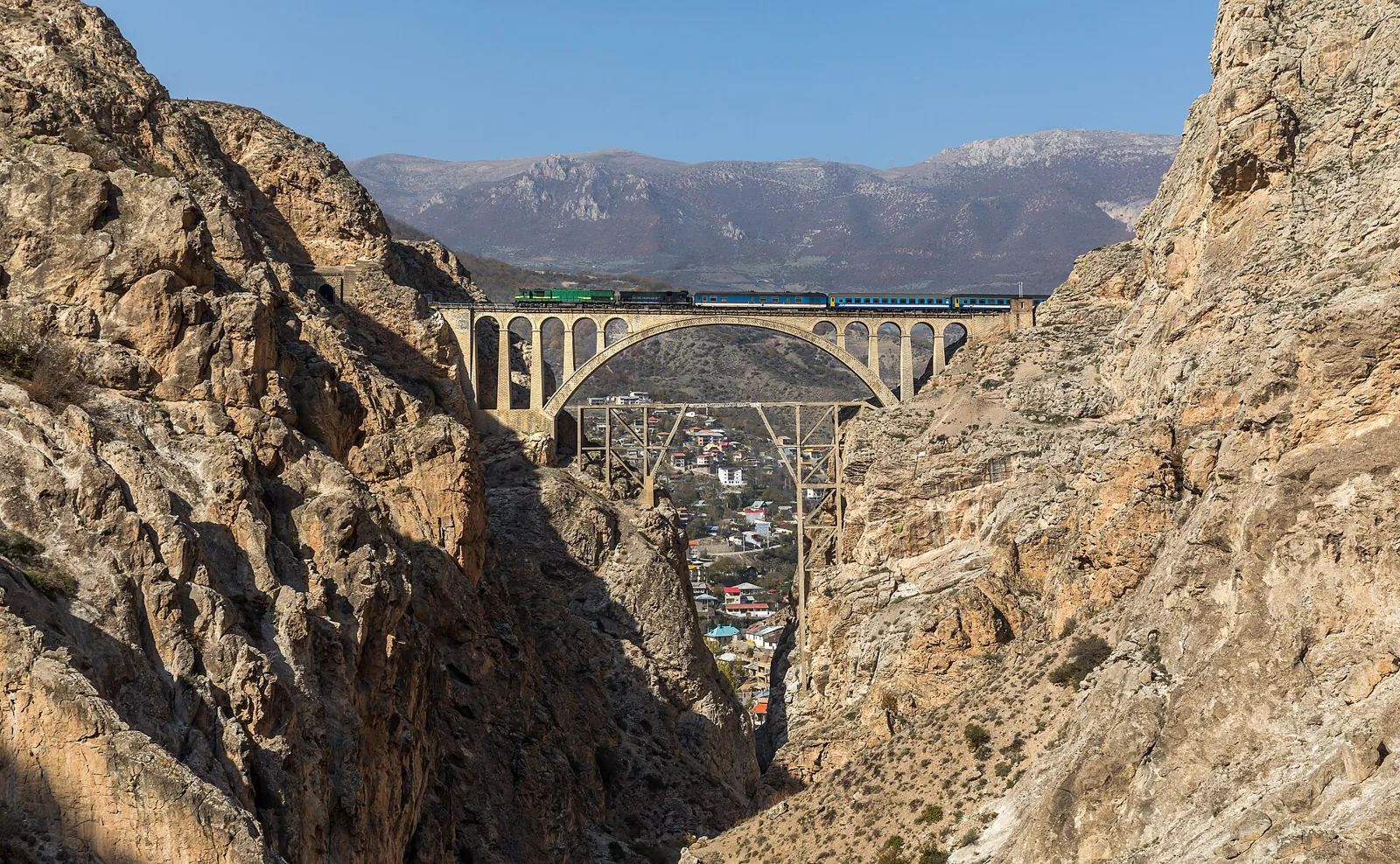
The Veresk Bridge illustrates how infrastructure can become an architectural landmark. A photograph captures its relationship with a mountain valley, but cannot establish maintenance condition, permitted access or present train operations.
Do not enter tracks, construction compounds or restricted railway land for a better viewpoint. Transport and security facilities can carry photography restrictions even where the landscape looks inviting.
Water systems before the megaproject era
Yazd shows why infrastructure history should include underground water distribution, shaded lanes and buildings designed around limited resources. Traditional qanats and wind-catchers are distinct technologies: one concerns water movement, the other helps ventilation.
Modern sustainability claims need evidence about water availability, maintenance and community use. A picturesque historic system should not be used as proof that present-day water pressures have been solved.
How to evaluate a new development claim
- Identify the project owner and the exact location.
- Separate proposed, financed, under construction, partially operating and completed stages.
- Look for a dated completion record and actual service information.
- Check environmental and local-community effects alongside headline capacity.
For cross-border corridors, distinguish a signed agreement from a completed connection. Capacity quoted in a proposal is not measured annual traffic, and projected jobs are not jobs already created.
Business and funding constraints
Foreign participation can be affected by sanctions, export controls, banking restrictions and the identity of every counterparty. A domestic permit does not settle the laws applying to an overseas investor or supplier.
Our Iran business setup overview explains the due-diligence questions. Do not route transactions through intermediaries to disguise a restricted purpose or party.
A practical reader's checklist
If evaluating a property or workplace, ask about actual electricity, water, internet and transport reliability at that address. Obtain contractual responsibility for outages and alternatives instead of relying on a national headline.
Our Iran country guide provides historical context. This article describes infrastructure and verification methods; it does not announce unverified project completions or recommend travel under current warnings.
Sources and photograph credit
Information checked 29 October 2026. Fees, hours, eligibility and project status can change; confirm with the relevant official authority before paying or travelling.
Photograph: Kabelleger / David Gubler; RAI 60-878 Veresk.jpg; CC BY-SA 4.0. Source-recorded date: 2017-10-31 11:40:33. Resized and converted to WebP for the web. Genuine photograph; not a live view or a claim of present-day conditions.
